European Heat Wave

The immediate outlook for oil prices is increasingly bleak.
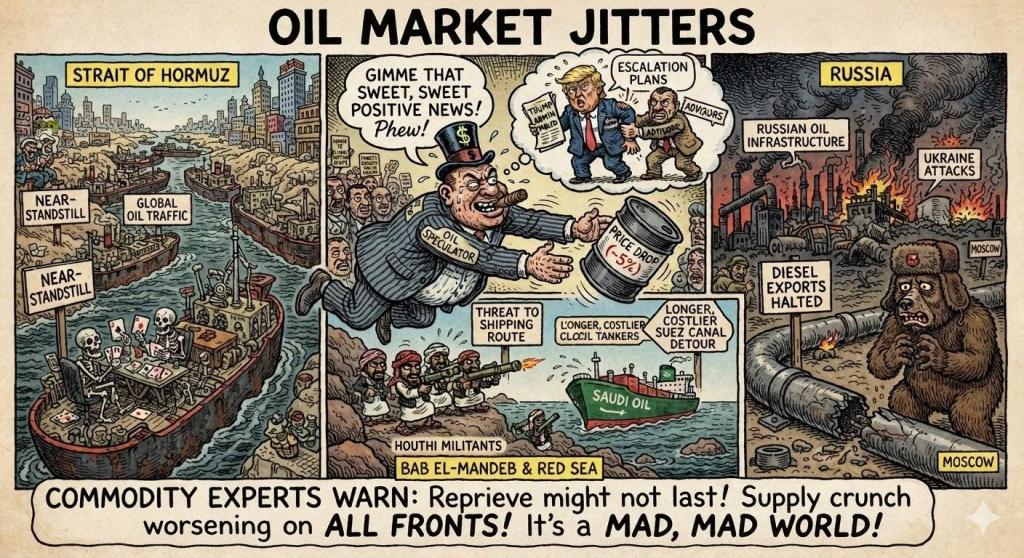
President Trump pledged to attack bridges and power plants in response to Iranian attacks in the Strait of Hormuz. The Iranian-backed Houthi militia in Yemen has declared a blockade of the Red Sea to prevent Saudi Arabian oil exports. Domestic oil reserves have fallen to their lowest levels since the early 1980s. In response, international oil prices touched $100 per barrel Thursday morning.
Yet investors appear sanguine about the path ahead. They have continued to bet that, in the end, the current escalation in the war with Iran will be short-lived and that oil prices, which have jumped in recent weeks, will fall in the coming months.
Oil trading largely takes place in the futures market, where prices to buy or sell the commodity at a future date are fixed. The most often cited oil prices are those that are closest to the present day, reflecting traders’ immediate concerns for the market.
There is reason for hope in the oil markets. Namely, that the Iran situation may resolve itself and if it doesn't and there is a dramatic short term spike in oil prices, it may come with demand destruction as people cancel vacations and trips - and use more pubic transport. Moreover, summer is coming to a close rapidly, ending the summer driving season and the winter looks mild so less heating oil demand. But nobody can predict the future, at best it's just a guess. And the politicians have nothing to win by having excessively high oil prices come October and November.
We're powering up like never before! In this video, we install the new and improved Eco-Worthy Solar Tracker—now featuring bifacial solar panels for maximum efficiency. This upgraded system is a game changer for our life at the remote off-grid cabin deep in the wilderness of Northern Michigan.
After taking down our old setup, we’re finally putting the tracker back up—and this version is better than ever. Watch as we walk through the full install, share why this system matters so much to our daily life off-grid, and show you how well it performs in action.