Many of the hallmarks of the 1973 shock were a result of poor domestic policy decisions, and the hit to supply is far greater now, said Bob McNally, president of Rapidan Energy Group, a research firm. Policies like rationing set off panic buying, creating shortages instead of easing the problem.
The 1973 embargoed oil accounted for about 7 percent of global oil consumption, and targeted only a handful of nations. That meant the United States could still buy some oil from other countries.
Now, closer to 20 percent of the world’s supply is threatened, and the disruption is caused by a war that has no end in sight. The United States, Israel and Iran are all dug in, and daily threats to oil production, refining and storage mean that even when ships can sail again the supply might not come back quickly.
The conflict has the potential to cause a lasting inflationary cycle, as rising prices for everything from diesel to fertilizer are passed on. That could add pressure on a world economy that is already contending with President Trump’s trade war.
The war in the Middle East is creating the largest supply disruption in the history of the global oil market. With crude and oil product flows through the Strait of Hormuz plunging from around 20 mb/d before the war to a trickle currently, limited capacity available to bypass the crucial waterway, and storage filling up, Gulf countries have cut total oil production by at least 10 mb/d. In the absence of a rapid resumption of shipping flows, supply losses are set to increase.
Global oil supply is projected to plunge by 8 mb/d in March, with curtailments in the Middle East partly offset by higher output from non-OPEC producers, Kazakhstan and Russia following disruptions at the start of the year. While the extent of losses will depend on the duration of the conflict and disruptions to flows, we estimate global oil supply to rise by 1.1 mb/d in 2026 on average, with non-OPEC producers accounting for the entire increase.
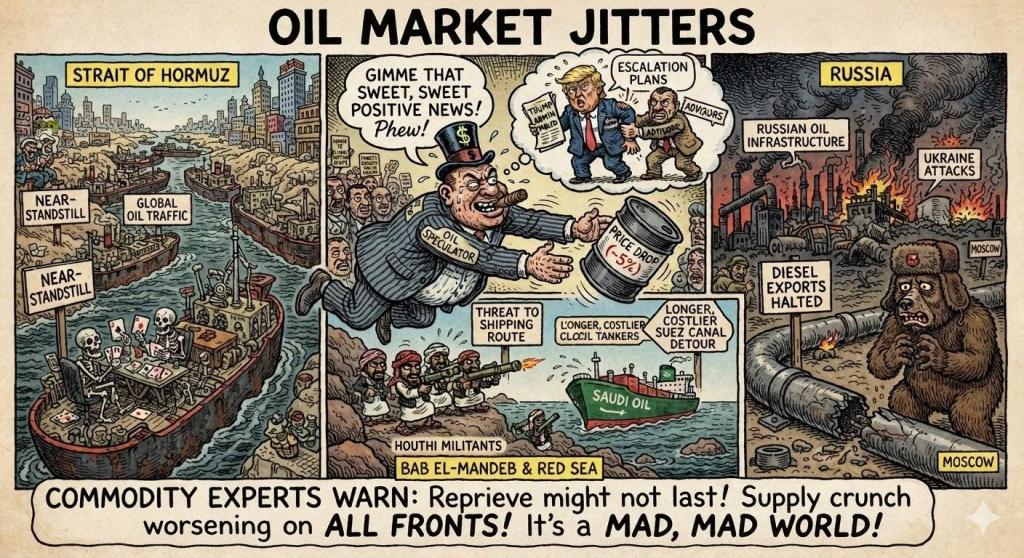
The conflict is also having a significant impact on global product markets, with export flows through the Strait at a near standstill. Gulf producers exported 3.3 mb/d of refined products and 1.5 mb/d of LPG in 2025. More than 3 mb/d of refining capacity in the region has already shut due to attacks and a lack of viable export outlets. Runs elsewhere will be increasingly limited due to feedstock availability.
The Strait of Hormuz is currently the center of a severe global crisis following its effective closure by Iran on March 2, 2026. As the world's most critical oil chokepoint, the strait facilitates the transit of approximately 20% of the global oil supply (roughly 20–21 million barrels per day) and 20% of liquefied natural gas (LNG).
The leaders of industrialized nations were racing on Wednesday to shore up the global oil supply, after three ships in the Persian Gulf and Strait of Hormuz came under attack, in a stark illustration of how the war in the Middle East is threatening to choke off one of the key conduits for international trade. Japan, Germany and Austria will release oil from their strategic reserves in response to disruptions in the supply from the Middle East, officials in those countries said on Wednesday. They made the announcements hours before a meeting of leaders of the Group of 7 industrialized nations, including the United States, to discuss jointly releasing oil in consultation with the International Energy Agency. The attacks, which occurred within a few hours of each other, marked a sharp uptick in strikes on vessels in or near the Strait of Hormuz, through which a fifth of the world’s oil transits. On Tuesday, the U.S. military said that it had attacked 16 Iranian mine-laying vessels near the strait, where tanker traffic has been largely paused for days because of concerns that drones or missiles could hit merchant ships.
Oil prices rose, while U.S. stock futures were slightly lower on Wednesday amid continuing attacks on Iran and Iranian retaliatory strikes targeted at Israel and American allies in the region. Investors across the world are keenly focused on the Strait of Hormuz, a narrow waterway between Iran and Oman that separates the world’s biggest oil and natural gas producers from their customers. The strait carries one-fifth of the world’s oil and a significant amount of natural gas. Traffic through the strait has been effectively halted because of the risk that vessels could be attacked. On Tuesday, the U.S. military said its forces had attacked 16 Iranian mine-laying vessels near the strait. Trump administration officials have suggested the possibility of naval escorts for commercial vessels to mitigate the danger.
It has been another wild day of trading in oil markets.
Futures for Brent crude, the global benchmark, dropped 11% to $87.80 a barrel, deepening a decline that began after they briefly surged to their highest intraday level since 2022.
Behind the slide: hopes the world’s biggest economies will release strategic oil reserves and comments from President Trump signaling a limit to the duration of hostilities.
Oil's decline helped boost stocks around the world on Tuesday, though U.S. indexes trimmed gains and crude pared declines after a social media post from Energy Secretary Chris Wright saying the U.S. Navy had successfully escorted a tanker through the Strait of Hormuz was deleted. The Navy isn’t now escorting commercial ships through the strait, according to the White House and a spokesman for U.S. Central Command.